How to Measure a Box for Shipping and Packaging
Accurate box measurements are essential for safe and cost-effective shipping. Whether you run an online store, manufacture products, or occasionally ship packages, knowing how to measure a box correctly helps you choose the right packaging and avoid unnecessary expenses. Even a small measuring mistake can result in higher shipping charges, wasted packing materials, or a poor fit that leaves products vulnerable to damage.
Shipping carriers rely on box dimensions to calculate rates, while packaging manufacturers use measurements to produce boxes that match your product. Learning the correct method takes only a few minutes, but it can save both time and money in the long run.
This guide explains everything you need to know about measuring a box accurately, avoiding common mistakes, and selecting packaging that meets your shipping needs, especially when ordering custom packaging boxes.
Why Measuring a Box Correctly Matters
Many people assume that measuring a box is straightforward, but accuracy is more important than it may seem. First, proper measurements help reduce shipping costs. Most major shipping carriers calculate rates using both the weight and size of a package. If the dimensions are larger than necessary, you may pay more than required.
Second, correctly sized packaging protects products during transit. A box that is too large allows items to shift, increasing the chance of damage. A box that is too small may place pressure on the product or leave no room for protective cushioning. Finally, accurate measurements improve inventory management. Standardized box sizes are easier to store, organize, and reorder, making warehouse operations more efficient.
Tools You’ll Need
Before measuring a box, gather a few basic tools.
Measuring Tape or Ruler
A flexible measuring tape works well for larger boxes, while a ruler is suitable for smaller packaging.
Flat Surface
Place the box on a level surface to ensure accurate measurements.
Notebook or Digital Device
Record each measurement immediately to avoid confusion, especially when measuring multiple boxes.
Calculator
A calculator is useful if you need to determine dimensional weight or compare box sizes for shipping costs.
Understanding Box Dimensions
Every shipping box has three basic dimensions:
Length
Length is the longest side of the box when viewed from the top.
Width
Width is the shorter side that runs perpendicular to the length.
Height
Height is measured from the bottom of the box to the top while the box is standing in its normal shipping position.
Standard Measurement Order
Box dimensions are always written in the same order:
Length × Width × Height (L × W × H)
Following this format helps prevent confusion when ordering packaging or requesting shipping quotes.
Inside vs. Outside Dimensions
Packaging manufacturers often use inside dimensions because they determine how well a product fits inside the box. Shipping companies, however, usually consider the outside dimensions when calculating shipping costs.
Knowing which measurement is required helps avoid ordering the wrong size.
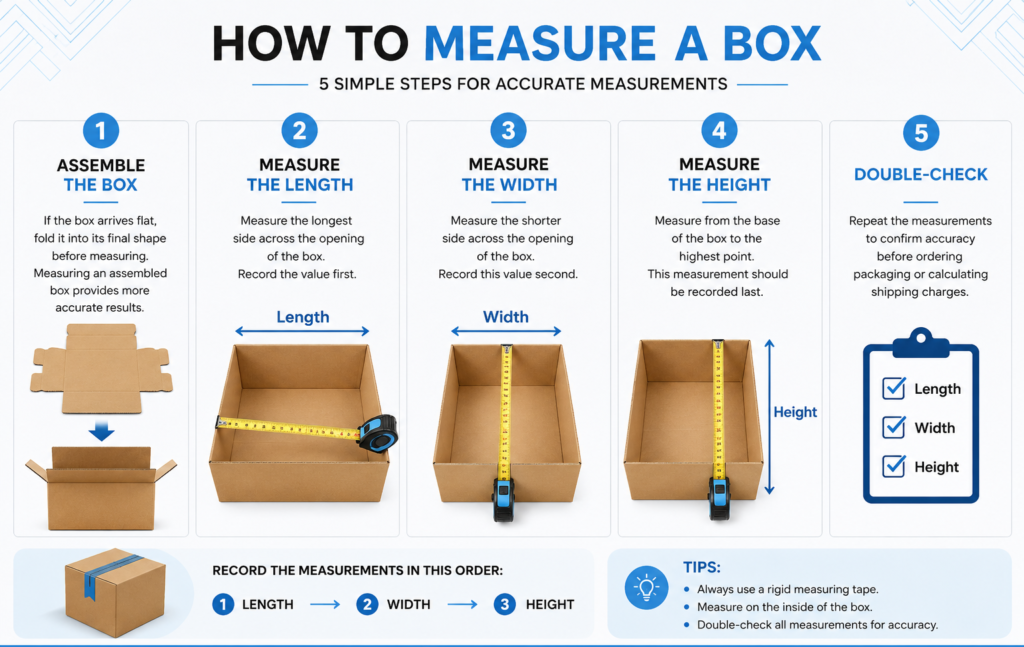
How to Measure a Box Step by Step
Measuring a box accurately is simple when you follow a consistent process.
Step 1: Assemble the Box
If the box arrives flat, fold it into its final shape before measuring. Measuring an assembled box provides more accurate results.
Step 2: Measure the Length
Measure the longest side across the opening of the box. Record the value first.
Step 3: Measure the Width
Measure the shorter side across the opening. Record this value second.
Step 4: Measure the Height
Measure from the base of the box to the highest point. This measurement should be recorded last.
Step 5: Double-Check
Repeat the measurements to confirm accuracy before ordering packaging or calculating shipping charges.
Common Mistakes to Avoid
Even experienced shippers occasionally make measuring errors. One common mistake is recording dimensions in the wrong order. Always use Length × Width × Height to avoid confusion. Another mistake is estimating instead of measuring. Even slight differences can affect shipping costs. Some people forget to allow space for protective materials such as bubble wrap or foam inserts. Products should fit securely while leaving enough room for cushioning.
Finally, avoid rounding measurements excessively. Accurate measurements produce more reliable shipping estimates and better-fitting packaging.
Choosing the Right Box Size
The best box is one that protects the product without adding unnecessary bulk. Choose a box that leaves enough room for cushioning while minimizing empty space. Oversized boxes increase shipping costs and often require additional packing materials.
Consider the weight of the product as well. Heavier items require stronger box materials to prevent crushing during transportation. It is also helpful to think about storage. Standardized box sizes simplify warehouse organization and reduce inventory complexity. Testing several box sizes before placing a large order can help identify the most efficient option.
Shipping Considerations Beyond Measurements
Box dimensions are only one part of the shipping process. Many shipping companies use dimensional weight pricing, which considers both the size and weight of a package. A lightweight but oversized box may cost more to ship than a smaller, heavier package.
Proper cushioning is equally important. Foam inserts, packing paper, and air pillows help protect products during transit while preventing movement inside the box. Labels should always be placed on a flat surface where they remain easy to scan throughout the shipping process.
Businesses shipping internationally should also review carrier guidelines to ensure their packages meet size and weight restrictions.
Practical Measurement Examples
Understanding measurements becomes easier with a few simple examples. A shoe box might measure 14 × 8 × 5 inches. The longest side is the length, the shorter side is the width, and the vertical distance is the height. A shipping carton for kitchen appliances could measure 24 × 18 × 16 inches, leaving space for protective foam around the product.
If you manufacture a custom product, measure the product first, then add enough space for cushioning before determining the final box dimensions. Using the same measuring method every time helps maintain consistency across all packaging orders.
Why Businesses Choose Packaging Lane
Choosing the right packaging supplier can make the entire packaging process easier and more efficient. Packaging Lane helps businesses find solutions that match their products, shipping requirements, and branding goals.
Whether you need Custom Packaging Boxes for retail, eCommerce, or industrial products, their experienced team provides guidance from design through production. Businesses looking for reliable custom boxes can benefit from a wide selection of sizes, materials, and printing options designed to improve both product protection and presentation.
Packaging experts also help customers measure a box correctly before production begins, reducing the risk of sizing errors and unnecessary costs. By carefully reviewing your package dimensions, Packaging Lane helps ensure every box is manufactured to fit your products accurately while supporting efficient shipping and storage.
Conclusion
Measuring a box correctly is a simple skill that has a significant impact on shipping costs, product protection, and customer satisfaction. By understanding the standard measurement order, avoiding common mistakes, and selecting the appropriate box size, businesses can improve efficiency while reducing unnecessary expenses.
Taking accurate measurements before ordering packaging also helps prevent delays, minimizes product damage, and creates a better experience for customers from the moment they receive their shipment. Whether you’re shipping a single product or managing large-scale operations, investing a little extra time in accurate measurements will pay off in the long run. When you’re ready to create professionally sized custom packaging boxes, working with an experienced packaging partner can help ensure every shipment is protected, cost-effective, and ready to make a great first impression.